Saturday, November 26, 2011

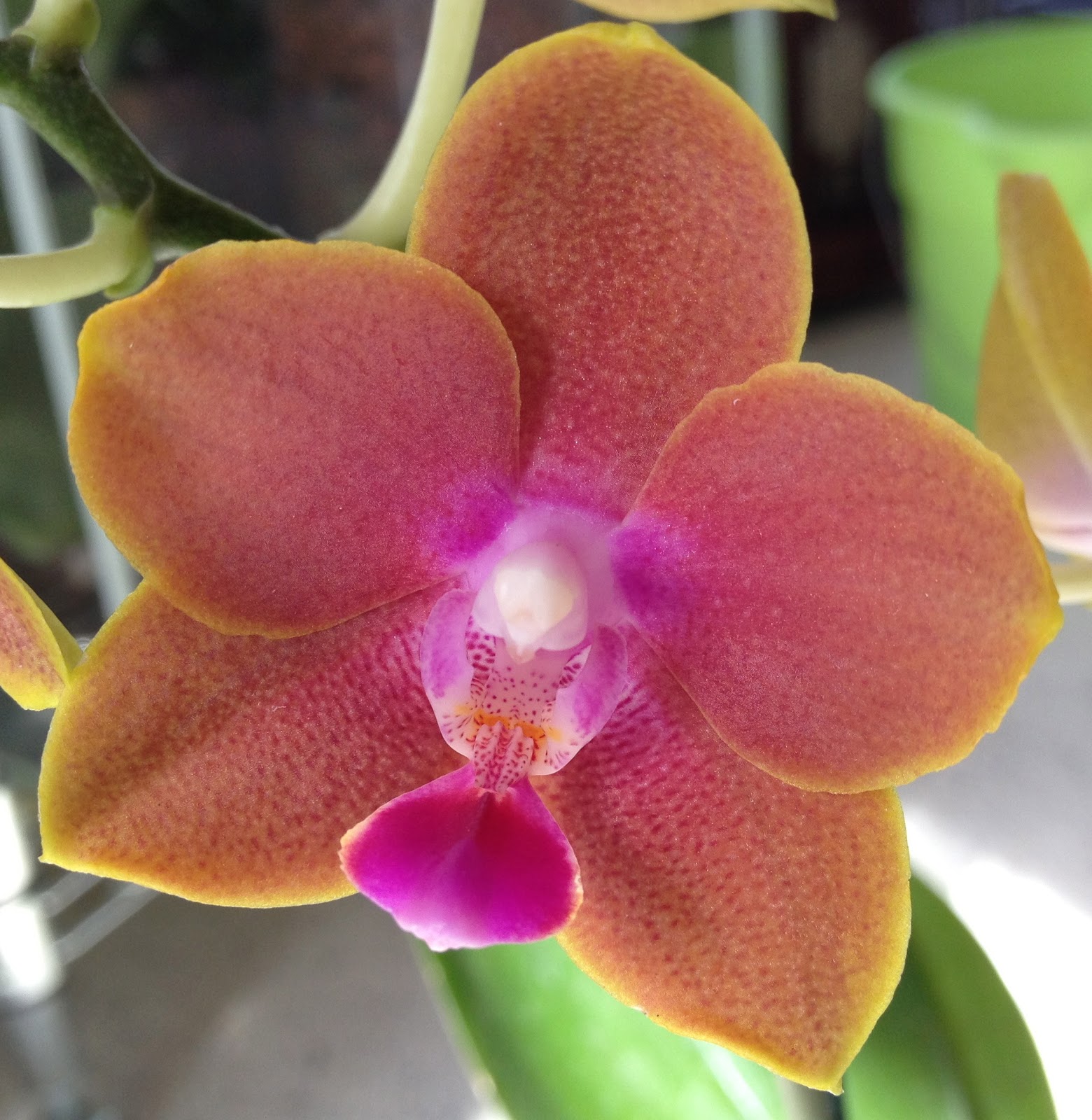
Phal. Tying Shin Cupid 'Montclair' (Sogo Lawrence x Kuntrarti Rarashati)

Tying Shin Cupid 'Montclair' is a fantastic addition to my collection.  With a light scent made apparent during the warming-hours of the day, this phal boasts some of the most intense coloration I've seen on a phal bloom.  It is also of heavy, almost waxy substance, which means it likely has blooms that will last for a long time.  Its pod parent, Sogo Lawrence, has been used extensively by the Tying Shin nursery.  I have my own Sogo Lawrence as seen below.

Photo & Video Sharing by SmugMug

Phal Kuntrarti Rarashati
If you combine the two with some careful consideration, it gives you Tying Shin Cupid 'Montclair'.

P. Tying Shin Cupid 'Montclair'
From Orchids.com description from their website:
Another exceptional clone of this incredible FRAGRANT hybrid from the famous Tying Shin Nursery in Taiwan ! Phal. Tying Shin Cupid is being used extensively in their breeding program, lending its smaller size, floriferousness, waxy substance, fragrance and brilliant sunset tones to all its progeny. First bloom seedlings often produce more than one spike and when fully mature, are capable of producing multitudes of branching sprays. A must for multi-floral miniature collectors and essential for any breeding program

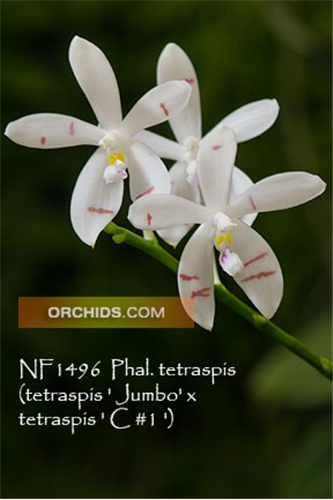
Phal. tetraspis (tetraspis ' Jumbo' x tetraspis ' C #1 ')

One of my latest additions to my collection is this species, Tetraspis.  It is actually the progeny of a mated pair of the same species, but one that is pure white and one that has the classic light barring.  The pure white version brings to the plant a strong vanilla scent and a larger bloom and the classic species brings the barring.  When I bought this plant from Orchids.com the made it very clear that you would have no idea really what you'd get.  The basics of genetics dictate that you'd get roughly 1/3 white, 1/3 barred and 1/3 of something in between.  Of course genetics is more complicated than that but for my purposes, it'll suffice.

The photo from Orchids.com website (not my photo!)
I have to admit I have I wanted one with barring but the allure of having a fragrant phal was too much for me to resist so I bought one.  When I received the plant, it had already grown several spikes that had clearly bloomed.  Fortunately for me, a change in conditions for most phals will send the plant into another round of blooming-- and this one did not disappoint.

And here is the latest on my own:
On one spike you can find what looks like a completely white bloom. :o(
But on this spike you can see a bar has clearly begun to develop.
Species are known to take their time in blooming so hopefully I won't have to wait long to see what this plant has to offer.

Tuesday, April 26, 2011

The Question: Why?

The Question: Why?


Changing everything-- from diet to hygiene and more

25 April 2011


Growing a vegetable garden these days has become more common-- especially with the sudden rise and attendance of farmer's markets in local communities and such. But even with keeping a garden, most people tend to stick to the things they like the most-- which is natural. Tomatoes, lettuce, maybe broccoli. But what if you take it one step further-- or two or three steps? What does a garden become? For me, it's transforming into a new way of living.


I grew up on a farm in Pennsylvania-- nestled in Dutch country, I was surrounded by farming communities, intermingled with white-collar businesses for those who liked the scenery of the country, but not necessarily to live off the country. The farm was a dairy farm but also had loads of land for crops. Most of the crops were for the cows, but that didn't mean it couldn't yield food stuff beyond what the cows needed or wanted. I remember my dad selling soybeans and alfalfa on a regular basis to other farms and through local auctions. We lived off of the milk those cows provided and off the meat the steers would provide every year. On occasion we would even butcher pigs and chickens-- it was a working farm, after all. It was a way of life I knew-- I knew of no other and it's interesting now as an adult to look back and examine that way of life and just how far removed I am from it.


A few months back, Carrie began looking into natural products. I look to Dr Bronner's Soap as the catalyst that began the transformation or how we use, procure and dispose of things. For those not familiar with Dr Bronner's Soap, it comes in many forms but the one I'm used to is castile soap that is highly concentrated-- a drop goes a very long way. Dr Bronner and his family (I believe the good Dr has since passed) are committed to making natural, bio-based soaps that are meant to simply clean, not destroy every living thing in it's path-- and it does just that. Anyway, this gate-way "drug" into the natural products world is what opened up my eyes to not only the possibilities, but the insanity of my daily living and just how much toxicity I lived in. I even considered myself a environment-conscious individual and a clean one at that!


Dr Bronner's was about as far as I was willing to go at first. It's like trying out something before buying-- you are skeptical of the new product or new way of doing something and need proof to further invest yourself in something that could change your way of life. I wish kids were this way, but they seem to be an all-or-nothing product. Carrie really focused on the cosmetic side of things, though-- mostly because of her epic struggle to find things that work for her but also because Colorado has some of the driest air you'll ever experience and she uses a lot of moisturizers etc-- well these products have some of the most bizarre ingredients, most of which haven't a single drop of naturally occurring elements in them. I on the other hand looked at food. Why food? Well, we all have our reasons for things, right?


Because of a personal health issue, my attention turned to food. I never considered myself an unhealthy eater but looking back, there were some serious flaws. I ate vegetables and fruits but I also ate a lot of meat (maybe not compared to others but compared to now, definitely). The amazing thing is, I could not tell you one single thing about where my food came from. Was it local produce? Was the hamburger from the next town over? Where was the bread baked? No idea… absolutely none. And I should know better, right? I mean, I grew up on a dairy farm in Pennsylvania where were knew precisely where our milk came from-- where our cows were butchered and our ham cured (our farm!). I am many years removed from that way of life and sadly, I slowly and quietly progressed the point where I am now-- wondering where my food comes from and why the food I eat is not necessarily helping my body.


My change in eating and in my food is simple-- I learned too much bad stuff about the food industry. Monsanto is not a tool of the Devil, but just might be the Devil itself! (Devil claim is a personal belief of mine and is not based in fact) This company, in particular, has been the focus of some more recent outrage in the food industry. Companies like this are pure evil and are taking ingenuity, tried-and-true traditions and the very essence of living off the land and stomping on it with its huge, well-funded legal boot. Monsanto and others like it are unwelcome in my life and are strongly urged to stay out of my wallet. Given that our food industry is controlled by very few companies now, it is near-impossible to cut them out of the loop, but I'll never stop working to that end. Other issues focus squarely on meat. I love meat-- especially a good hamburger (steaks are nice but they mess with my stomach too much!) but the cost of raising an animal under healthy circumstances and butchering it humanely makes meat very expensive. (The American Association of Meat Processors is an organization that lobbies for major meat-producers-- and nothing says trust than a huge lobby with a logo that has a piece of meat in it! A law suit from a Brazilian company about producing bad meat in the US). I should mention at this point that I'm not a huge fan of using my money, either, especially when I know it goes to corporations instead of my neighbors. The economic impact on me and the ecological impact on our land is a good enough case for me to simply lower-- even by half-- the amount of meat I consume. It feels odd to say it, mostly because of the stigma around diet and food in this country, but I've changed my diet from meat-based vegetable supported to vegetable-based meat supported. And though we're still using up our supply of store-bought meat, our plan is to purchase our next order of meat from a local butcher. It'll cost a lot, I'm sure-- but the responsibility that goes with how we live and operate on this planet falls on the individual. I'm tired of shrugging off my responsibility for the sake of cheap food that makes me sick.


Knowing where my food comes from is the major factor that drives the changes in how I live. My experience and childhood on the farm is something I long to return to. It wasn't an easy life-- my parents and my siblings all worked very hard and went without plenty of things to make life work on the farm but times are different and I'm also not running a farm-- rather, I'm introducing things I know are good and though they may not be easy-to-do, they are much better than the alternatives. So for the first time since leaving the farm, we have a vegetable garden planted. It is 400 square feet and I'm stoked to learn how much money we save (if any) in terms of produce that we get out of the garden. We have plans to freeze, can, preserve… you name it. We also bought chickens. Yep. Chickens. Sybil, Helen and Edith are three buff orpingtons that we got just over a month ago and they are here for one purpose-- eggs. But they're also here for other reasons-- they give great compost, eat bugs in the garden and are funny as hell. One day they'll even be on our table-- but that's not for a while yet! We eat a lot of eggs, mostly because they're cheap, readily available and a good source of protein and good fat but there is a catch-- they're produced from birds that are kept in some of the more outrageous conditions. You'll hear the term "organic" or "cage free" and think you're getting eggs from happy chickens-- but this could not be further from the truth. Eggland's Best defines cage free as, "The hens selected to lay Eggland’s Best Cage Free eggs are not kept in cages and are free to roam. The hens are provided with sunlight, shade, shelter, an exercise area, fresh air, and are protected from predators." If by "free to roam" you mean housed in a huge-yet-jam-packed metal box, then no, they are not in cages. I don't mean to pick on this particular company because I have no specific quarrel with them but I find it very difficult to believe they provide a humane existence for these birds and give them what they need to produce the best-quality egg out there. And I'm not saying I can do any better but at least I know where my eggs are coming from-- my yard.


This movement to a more natural way of life makes sense to me. It takes work and thought but it is rewarding and I enjoy the work. I've even come to enjoy the look on people's faces when they hear I have chickens! It's the "are you nuts" look-- classic. And no, I'm not nuts, it is perfectly natural to have such animals in my care and on my land. Nowhere else in the World, than in America, does one buy acreage of land and not use it for a single agricultural purpose. I like having several acres of land, as it keeps other people away from me, has a great view of the mountains and is full of birds and deer and other cool animals-- but it is land! It can be used responsibly to provide me and my family and in the healthiest way possible. To me, there is no question as to whether or not to do this-- the answer is clear.

Sunday, June 20, 2010

H. Siren, Stanwick, and NOID


I kept a few bulbs chilled in our fridge over the winter months figuring that I could have extended bloomed later on during the gap between Winter and Spring, or when Spring has an identity crisis and acts like Winter, which it so often does here in Colorado. But then I moved and the bulbs had no chilling and suddenly came to life. So I ended up potting them in semi-hydro and letting them grow happily in the new sunroom. One of those bulbs is Siren-- a double flower that is both red and white, witch a lot of shading and speckling in between. She gave me two scapes this year. The first was the typical four per scape. Here is the first round of flowers.


The blooms are beautiful but it was the second scape the surprised me most about this particular bulb. I hope it always does this...


I counted and got 8 full blooms on the second scape. Saweet!!!!!!

Around the same time as Siren's blooming I was lucky to have two others blooming as well. The first is Stanwick, which is an Australian hybrid. This is the first bulb I've ever grown hydroponically and is the second bloom for this particular bulb. I did run into a bit of a problem with this one, though. Its roots turned black while in the hydro. At first I thought maybe the plant lived its useful life in hydro and that the environment simply went toxic or something to that effect. But it is my belief that the roots just got too hot, as not all of them died. I repotted the bulb and hopefully its root system is rebounding now.


And finally, we have a NOID. It was supposed to be Rembrandt von Rijn but looks to me more like a dirty Picotee. It is really nice looking anyway, so it'll just in my collection as Picotee.


I apologize for the terrible pics-- they were taken on my cell phone and due to the ease of uploading from the phone, that has been the choice method lately, as time just isn't available for more!

Saturday, April 24, 2010

Phal Rousserole x (Carmerla's Wild Thing X Adelaides Delight)

Phal Rousserole x (Carmerla's Wild Thing X Adelaides Delight)

I bought this Phal off of Ebay from a seller, Mijo. He sells many phals throughout the year and they're always these strange crosses. Well I fell in love with this one and had to have it. I love the dots! When I first got the plant, it was about to bloom and over the month, three buds opened and that was the extent of the show. However, the plant did very well in hydroton and grew substantially over the next year and the photo below is of this season's blooms. Funny thing, though, is that instead of a lot more blooms, I only got one more for a total of four. I'm not complaining because I love this plant, but the plant is very healthy and large now and sent up a long graceful spike only for four blooms.

Another thing I like about this plant are the unbloomed buds. Most phals have pretty boring looking buds but this one has this amazing blend of lavender, green, purples all mixed together to make even the unbloomed flower a work of art.

This variety is a long-lasting bloom.


Haworthia Cymbiformis var translucens

Haworthia Cymbiformis var translucens, Eastern Cape of South Africa

This plant was a gift from a friend of mine from a few of the garden forums I frequent on the Internet. It is a stunning succulent that I have never seen before but am captivated by its look and form. Many succulents that bear some sort of translucency usually only have a small 'window' of translucent flesh but is protected otherwise by a more solid green flesh that blocks the intense sun from burning the plant. However, this plant seems to be most translucent and in so far as I can see, only the veins are solid green. It has only recently been acquired and it did not get potted as quickly as I would have normally done as I was moving to a new home-- so hopefully it'll show signs of being happy soon!


Sunday, March 21, 2010

Phal 'Ember'-- First Bloom

I present phal 'Ember'-- a smaller rich purple flower with a wax-like petal that is common among orchids that retain their blooms for extended periods of time-- anywhere from a month to several (even up to six!). Ember is an interesting plant not only because of its beautiful flower but because of the interesting floppy leaves it develops over time. The leaves start off as small, shiny/waxed leaves from the center and elongate to this impressive pale-green leaf that colors to a reddish purple colors near the tips. By itself, its quite impressive. This plant was bought from Logee's Greenhouse in Connecticut. A word about these guys-- impressive selection and excellent customer service. I cannot say enough about how awesome these guys are. Anyway, this plant began its spike in September 2009. If you're looking for a fast-growing, fast-flowering plant, this is not it. The spike is short, not long and arching like many phals are. I believe this is simply because of its lineage, of which I'm not sure, but the plant in general looks decidedly different from most other orchids and seems to relate in terms of leaf shape and look to those of violecea coerulea family-- these are found in hot and very tropical environments prone to a lot of rain-- hence the waxy look and feel of the plant.

Anyway, the spike is in fact short but full of blooms and is exhibiting several branches. None are growing much like the main spike but its likely they will continue on after the main spike subsides or stops growing. Again, this plant spiked in September 2009 and it bloomed on the first day of Spring! March 20 2010!

Without further delay... the bloom of phal 'Ember'-- a rich purple with an intense yet mouth-watering scent exhibited only in the morning (and if you're lucky, at sunset!).

Friday, March 19, 2010

A case for semi-hydroponics in orchid cultivation

All of my gardening friends know that I not only grow but preach to high heaven the wonders of growing plants- all of them- hydroponically. I use a material called hydroton that not only is able to hold water but wicks moisture quickly and provides a beneficial humidity to new and existing roots that may not be actually in the water. The stuff has really allowed me to take out the guess work of growing my phals in bark or moss and by giving my plants an inorganic medium, I need not worry about rot and other bad things that come about as a result of using material in over time breaks down and releases toxins.

However, I inadvertently did a small study-- one group of phals grown in hydroton and another that were grow in other material due to their delicate health as a result of root-rot in bark. Now granted, the plants I'm focusing on here were not in the best of health, but to be fair, neither was one of their counterparts that has come to be known as my Monster Phal, because, well, its a monster.

So to the results-- three of my phals that had difficulty with their roots were placed in hydroton at a later date than the rest of my plants and therefore did not have a chance to grow as much as the others. And one might say-- well duh-- if they didn't grow as much of course they're not doing as well. However, these plants were all in bark. Something that most people use to grow these plants-- and many to great success. However, I've had no success with bark. And every plant that I have planted in hydroton last Spring or Summer has bloomed for me this year. So the appeal of hydroponics only increased for me. But the real vote was cast when I placed one of those ailing phals into a larger pot of hydroton as its roots were confused and were not doing well with growing into the water or medium. About three weeks after I planted it in a deeper pot and putting those roots into the medium, a spike appeared, the leaves are now full and shiny and it has grow new roots (as well as new parts to existing ones) into the medium.

I'm sold and convinced-- hydroponics rocks.

Wednesday, March 17, 2010

Busy busy...

Things have been crazy busy lately but I figured that while I have a moment of quite here late at night, I might as well take a chance to chronicle the goings on here.

The orchids are in full bloom and really putting on quite the display. Here is the first in the line-up-- Sogo Vivien x Dtps Taisuco Jewel, which has been really impressive this year. I'm looking forward watching this one get older-- some day it'll be an amazing display.


The next one is my Monster phal...or as I now have it labeled Phal 'Monster'-- because this thing grows like a weed and now has a spike that is only two inches shy of 3 feet. It's gatta have weed genes!


And the last of the orchid updates is my Kaleidescope. This is the first time this phal is blooming and has not disappointed at all.


The next photo is of a new plant to the collection-- Sedum 'Burrito'-- which I scored at my local garden center at a serious awesome price. I plan on growing it in a hanging pot so the 'burritos' can hang down. I think I found a new plant to collect-- sedums rock.


I also have one more addition to add and that is my hoya-- a hindu rope. Its pretty awesome but is planted in a soil I do not think is very good at all, though I hesitate to move it until I see some new growth suggesting the roots may be active, which will make the transition to hydroton much easier on the plant.


In preparation of moving my hindu rope to hydroton I decided to test the move on another hoya that is actively growing. I put it in a water catcher/pot slip because it gives a nice openness to the pot and I think will balance out the water vs air ration well for this hoya. The trick is to keep the soil roots happy long enough and until it gets water roots.


Well thats it for now... its bed time for this peep!

Monday, February 15, 2010

Some updates of Phals

Here are some update photos of my currently blooming Phals.


First is my Vivien 'Sogo' cross, which I think looks like it has a bunch of butterflies on it.

Next is 'Pauline', who continues to put on one heck of a show.


And next is my White Phal NOID. I love those tiger stripes! This one has several branches like my Vivien Sogo-- I expect an impressive showing.


Last but not least-- a group shot!!

Phal Balden's 'Kaleidescope'

Here is Balden's 'Kaleidescope'-- the first time this plant has ever bloomed. I love this flower-- it is so odd, busy, colorful and captivating all in one. It isn't your run-of-the-mill white phal with some added color here or there. That's not to say I don't love my white phals, because I do. But this one is just unique and strange.

Wednesday, February 3, 2010

Sogo Vivien x Dtps. Taisuco Jewel

Yesterday I posted a shot of my Vivien cross just beginning to open-- well last night she finished opening! Love the stripes on this one. This years bloom (so far doesn't seem to have as strong of striping on the lip as I remember it having last year. Below is the comparison.

Last Years Blooms

Current (2010) Blooms

Tuesday, February 2, 2010

An Update: 'Pauline', A NOID, Schilleriana, Another I can't remember, & 'Vivien'

Its been several weeks since I first spotted spikes on both my species, 'Schilleriana', and Balden's 'Kaleidescope' and both spikes are roughly 6-8 inches tall now. As seen here:


This is a terrible pic of this next one--

And my Schill continually amazes me because even while sporting new roots and a flower spike, I still get a new leaf coming in.


Next I have a 'Vivien' cross just now opening. This one sports stripes on everything-- petals, lips, you name it. If its a part of the flower, it has a stripe!

Next is a grocery store save-- a NOID-- but what I might call a standard white. It has yellow-green hues near the spotted center and really has a classic "moth orchid" look and feel to it.

It has loads of buds-in-waiting and it'll be fun to see it full of blooms within the next few weeks. This particular plant does a lot of branching, too. Where with some phals you get one long and arching inflorescence, this one may have only one spike, but many branches. It gives it a really nice effect.


'Pauline' and the NOID together, as seen below. 'Pauline' has several flowers open now and they look very good and healthy. She continues to grow her established buds, but for now, it looks like the spike has finished growing. That is how I bought her, too. A shorter spike but large and long-lasting blooms. I wonder if this is as big of a spike as she'll get. Either way, it looks great.

Sunday, January 31, 2010

A Miniature Phal, 'Zuma's Pixi"

Its only a guess as it came with no ID tags-- and pinpointing an exact name of a hybrid is near impossible based on just how many people hybridize these plants. However, I believe this plant is close to the Phal 'Zum's Pixi'. I especially like this phal because of the slight white picoteed edge.

Its spike bears a flush of inch or smaller blooms with a nice deep purple to light purple. This plant has been put into hydroponics already though I'm not certain it was totally ready. We'll see how it goes!

Dancing Queen-- A Full Court!

Dancing Queen is one of the best of the Hippeastrum family. And this season, my small clister (a group of attached bulbs) did not disappoint. Four scape for a total of over 16 flowers, nearly all at once!

Here is an example.


Dancing Queen, though not one of my first hydroponic experiments, is in hydroton now and was very quick to grow new roots in the new environment as seen below.

Phal 'Pauline'

I'm excited to say that I've managed to rebloom another one of my grocery store saves a few days ago with the blooming of Phal 'Pauline'. This, like many other phals, is a basic white but I like this one a lot because of the slight blushing that starts from the center and works itself outwards, fading to pure white. It also looks rather fake-- so much of the flower is delicate and has almost a milky/creme softness to it that, as my friend Ryan from Mesa said, it looks like someone painted it. The flowers grow rather close together, which gives it a sort of flush of color feel. However, the flowers are also rather large-- so unfortunately, you don't get to enjoy each flower on its own like you might with other phals but it is nonetheless one of the nicest blooms I have ever seen.

It is planted, like my other phals, in semi-hydroponics and has done very well. This particular plant was planted in a heavier soil-type medium when I bought it and I feared the roots would rot quickly. At the time is was showing new root growth so I planted it in s/h immediately upon taking it home. I believe because the roots were used to being so moist already that its transfer to s/h was no problem at all as it never lost its old roots, they even grew new branches of roots, and new ones grew as well. Over all, very lucky find and the plant did extremely well as it grew 3 or 4 new leaves during the short time I had it and before its current spike began to grow. Now onto the photos.

This first photo is of the flowers when I first bought the plant-- very nice flowers-- but the new ones look even better.

And here is the first bloom of the current spike-- by now, roughly 4 more have opened up.

Saturday, January 30, 2010

Semi-Hydroponic Growing

Semi-hydroponics is a system developed by a man in Pennsylvania by the name of Ray. His website is here.

It is a passive form of hydroponics and is considered semi-hydro because the entire root mass is not submerged in water. It is a set up where you have a hydroponic material such as hydroton, which can be found in any hydroponic store, that is placed inside a container that has holes drilled roughly 1/4-1/3 of the pots height from the bottom so that it creates a reservoir. It is this reservoir that the roots will reach for and during this time, the hydroton "wicks" water from the reservoir upwards so that the roots higher up get the moisture they need, too.

It has been reported that just about any plant can grow in s/h. Even succulents and cacti have been reported to thrive in such a condition. How is this possible? It is because of the physiology of the roots that develop after you put the plant into the s/h set up. Some call them water roots, but the roots that grow in the s/h conditions are grown being use to that condition-- the higher moisture/humidity, the openness of the medium and the constant weak availability of fertilizer.

So, if you want to put a plant from soil into s/h, it is important to time it properly so that your plant does not suffer. Because its current roots are soil roots, they will likely die away once in s/h. Do not worry yourself over this as most plants have not only the ability to quickly replace those roots, but the mere act of repotting stimulates root growth. However, it is important to choose your plant carefully-- it must be vibrant and healthy and in some cases, such as orchids, must be actively growing new roots. This is very important! Plants like orchids will suffer the loss of their roots and if they're not in there cycle where they are growing roots, you may lose the plant. No new roots? Have patience and look for a different plant that is actively growing new roots.

How is this all done?

First, choose your plant. Have it ready and keep it well watered (not drowning) as this will make them acclimate a bit better to the switch. Several days before (3-7 days) get your hydroton or similar medium and soak it. Every day or even several times a day, wash out the old water and soak again. The water will likely be dark, reddish brown. This is the dust coming off the medium. It must be washed away as most roots simply don't like the muck it creates. By washing it several times with a good soak, you should have clean medium soon. Also, by soaking it, you make available more water for evaporation for the initial few days of your plant's new home.

Once you've noticed the water running clean with your hydroton, it is time to plant your plant. Bring the plant to a sink or hose or tub where you can freely wash off soil and organic matter. It is important to get rid of as much soil as possible. Many roots will cling to things such as perlite or charcoal. Don't pull this off if it doesn't come off with a gentle tug. This stuff isn't going to break down like organics will so if it doesn't come off, its ok to leave it on for now. But wash off as much as you possibly can.


For this tutorial, I've chosen a mini phalaenopsis that is currently in bloom (its ok to repot orchid in bloom!) that is pushing new root buds as well as bud on the existing roots. *Note about orchids, if the orchid was grown in heavy moss and kept moist, often the plant will acclimate well to s/h and may even retain its original roots* In the above photo, you can see my plant in its moss, its new pot and its already cleaned and soaked medium.

Next step is to drill two hole, roughly a 1/4 to 1/2 in apart from one another roughly 1/4th to 1/3rd of the height of the pot from the pots bottom. You are creating the space where the reservoir will be. I use a dremel to do this. Quick and easy. The drill bit is less than a 1/4 inch.


Next the drilling-- you can see how close the holes are. Hydroton and other similar mediums are roughly a uniform size. The reason for the two holes side-by-side? If one gets plugged, the hydroton that is blocking it will keep the other one from getting plugged, too.


Now the pot is ready for the hydroton.
I give the hydroton one final rinse before I use it in its new home. Be sure to really swish it around. This stuff has a way of releasing more dust as time goes by and giving it that last wash will give you peace of mind that it is in fact clean.


Next you prepare the plant. Here is my orchid in its moss.


*Note about keeping things clean* One of the best things about s/h is how clean you can keep things-- and certain plants, like orchids love to be clean! Most because of the potential for viruses and rot. So I have a mixture of water and Physan 20 on hand to spray down the plant, its roots, and all the things, including tools, that will touch it. Physan is also a good algaecide. I found mine on ebay for those who do not have it available in stores. Remove any and all organic matter from you plants roots and as you do, spray it down now and then with physan or similar disinfectants.

During this time, you must also inspect the roots and remove any dead or rotting/infected roots. Always use very sharp and clean tools for this. For orchids in particular, anything that is squishy, black, soft brown or that has lost its vellum (the fleshy outer part of the root) should be removed. The wire root on the inside of the vellum is useless without its fleshy outer part.

Once that is done, I give the roots a good wash again to get even more organics off the roots. Be careful with this-- many plants, including this phal, [i]do not like cold water[/i] or sudden changes in temps. Do be careful and test the water before you wash with it.
I then will spray it with physan again to completely drench the roots.
Here is my plant-- trimmed and cleaned and ready for its new home in s/h.
Fill up your new pot about half way up with hydroton.
Place the plant any way you'd like and spread the roots out so that they won't create dead spaces. Some dead space is ok but you want to fill in all areas as best as you can. I spread the roots out to the edges of the pot to give loads of room and so I can keep an eye on their health, as the pot is clear plastic.

Fill in the rest of the pot and tap the sides and bottom occasionally to get as much of the dead spaced as filled as possible.

Here are some of the roots that will give me an idea of the plants root system health.

And here is the plant in the end. But before it heads to the shelf, it needs its first good drink.

I use a weak fertilizer in my watering schedule because there are no organics in this system. Therefore you need to provide the food yourself. S/H can be messy because you must fill the pot to the top and let the excess run off. This is done so all the roots get a good drink and it refreshes the reservoir with fresh water, which can become problematic if weeks do by without new water. So when you do water, be prepared to catch the excess. Here's the new orchid doing its thing into the sink :lol:

And thats pretty much it. I'll edit this as I can with new/better/more concise info when i have time. But for now, the baby is awake and I gatta run!